Donald Trump is trying to force Canada to buy more American goods.
He may instead be accelerating something Washington has spent decades trying to prevent: a permanent Canadian economic pivot toward China.
With another round of punishing U.S. tariffs only days away, negotiations between Washington and Ottawa remain far apart. Trump has threatened 50% duties on nearly $20 billion worth of Canadian products beginning Aug. 19, escalating a trade confrontation already cutting into one of the most deeply integrated economic relationships in the world.
The White House says Canada has discriminated against American automobiles, dairy products and alcohol. It points to a 22% decline in Canadian imports of U.S. motor vehicles as evidence that American producers are being shut out. Canada says its measures are retaliation for tariffs Washington imposed first.
But while Washington and Ottawa argue about who started the trade war, something much more consequential is happening underneath it.
Canada is building escape routes.
China is entering Canada's automobile market. Canadian crude is increasingly reaching Asia through the Trans Mountain pipeline. China has already become the largest Asian buyer of Canadian oil, and Ottawa and Alberta have now backed another massive westbound pipeline designed to push even more energy toward Pacific markets.
That is the part of Trump's Canada strategy that could come back to haunt the United States.
For decades, geography gave Washington an extraordinary advantage. Canada produced enormous quantities of oil and had comparatively few practical places to sell it. Pipelines overwhelmingly ran south into the United States, where American refineries could absorb the heavy Canadian crude.
That gave the United States access to one of the largest, most politically secure petroleum reserves on Earth without tankers crossing oceans, without Hormuz and without relying on governments hostile to Washington.
Even after the Trans Mountain expansion opened a new route to the Pacific, roughly 90% of Canada's crude exports were still moving to the United States as recently as June.
That dependence is exactly what Canada is now trying to break.
China Just Got Through Canada's Front Door
The auto dispute shows how quickly the relationship is changing.
Canada still maintains retaliatory tariffs of 25% on U.S.-made vehicles that do not comply with CUSMA and on the non-Canadian and non-Mexican content of compliant U.S.-assembled vehicles. Those measures were imposed after Washington hit Canadian autos with its own tariffs.
Trump now wants those barriers removed.
Meanwhile, Canada has moved in precisely the opposite direction with China.
Earlier this year, Prime Minister Mark Carney's government struck an agreement allowing an initial 49,000 Chinese electric vehicles annually into Canada at the normal 6.1% most-favoured-nation tariff rather than the 100% surtax Canada previously imposed. The quota grows by 6.5% annually.
That may not sound enormous in a continent-sized auto market.
Strategically, it is.
Chinese automakers including BYD, Chery, Changan and Geely-owned brands have been moving to establish themselves in Canada, with industry analysts describing the country as a potential proving ground for Chinese manufacturers seeking experience in a North American market.
The contrast could hardly be sharper.
Washington is using tariffs to pressure its closest trading partner into purchasing more American vehicles at the same time Canada is creating a legal opening for China's fiercely competitive auto industry.
American automakers are already worried.
The North American manufacturers themselves are warning that changes to the regional trading system could add billions of dollars in annual costs. General Motors expects tariff-related expenses of roughly $2.5 billion to $3.5 billion this year, while Ford expects around a $1 billion hit.
And the competition arriving from China is not trivial.
Chinese manufacturers have spent years driving down EV production costs while scaling batteries, electronics, software and manufacturing capacity at extraordinary speed. BYD has become one of the world's dominant electric-vehicle manufacturers, and Chinese brands are aggressively expanding outside their domestic market.
Canada has now given them a North American beachhead.
The United States, meanwhile, has erected extremely high barriers against Chinese automobiles. Trump administration officials openly criticized Canada's decision in January, warning Ottawa that it would regret allowing Chinese EVs into the market.
But tariffs cannot force Canadian consumers to buy American vehicles.
They can make the relationship hostile enough that Canada becomes more willing to buy from somebody else.
The Oil Story Is Much Bigger
Cars matter.
Oil could matter far more.
American refineries have become deeply dependent on Canadian crude, particularly the heavy grades produced by Alberta's oil sands. Canada supplied 60% of all U.S. crude imports as far back as 2023, and refinery systems throughout the Midwest were built around the reliable flow of Canadian barrels.
That relationship developed partly because it made overwhelming economic sense for both countries.
Canada had oil.
America had enormous refining capacity.
A network of pipelines connected them.
The United States received secure continental supply, while Canadian producers gained dependable access to the world's largest economy.
The arrangement was so natural that Canada had little reason to build expensive alternatives.
Then Trans Mountain changed the map.
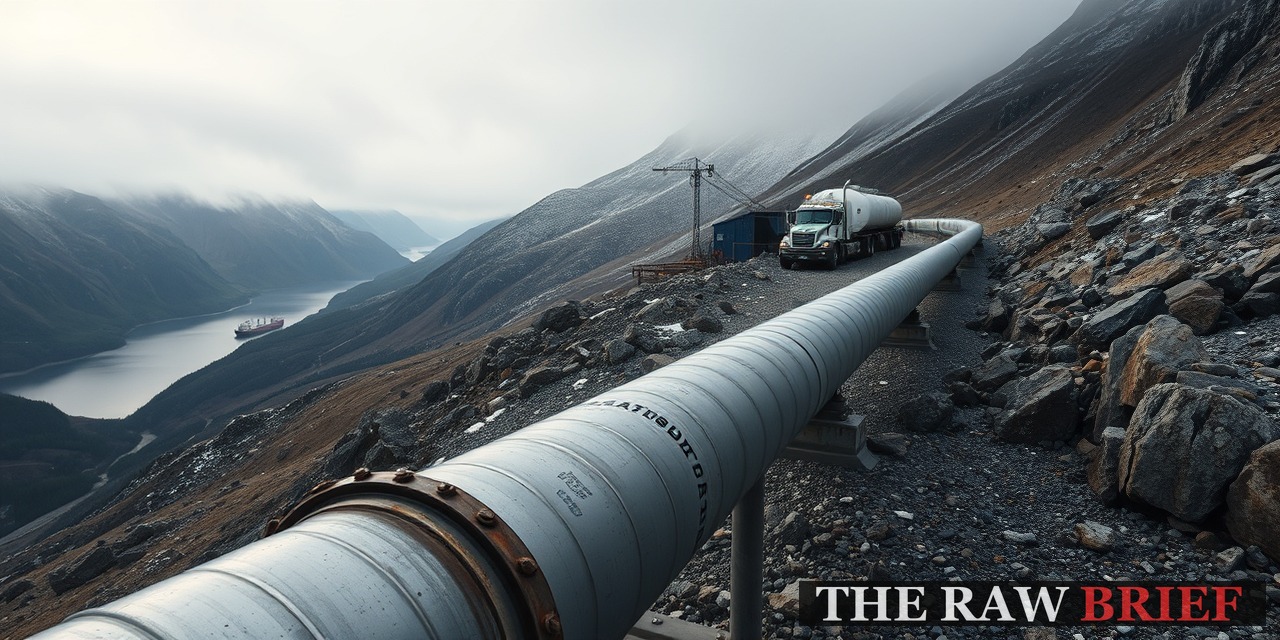
The C$34 billion expansion, completed in 2024, tripled the pipeline's capacity to approximately 890,000 barrels per day, giving Alberta a direct route to the Pacific Ocean.
And once that route opened, China showed up.
Since the expanded system ramped up, China has taken roughly 207,000 barrels per day through Trans Mountain, compared with approximately 173,000 barrels per day going to the United States from that system over the comparable period examined by Reuters.
China became Trans Mountain's largest buyer.
That represented a radical change.
Before the expansion, Canadian crude exports to China were tiny. Reuters reported that China had averaged only around 7,000 barrels per day from Canada during the decade through 2023.
Suddenly, Canada had another customer.
And that customer happened to be America's biggest strategic competitor.
Canadian crude exports to countries other than the United States surged nearly 60% in 2024 to a record annual average of approximately 183,000 barrels per day. China was joined by buyers including South Korea, Japan, India, Brunei and Taiwan.
The trend has not stopped.
The Iran war has made reliable non-Middle Eastern barrels even more valuable. With disruption around the Strait of Hormuz scrambling traditional crude flows, refiners in Asia have searched more aggressively for alternative supplies, including barrels from Canada. Canadian crude exported through Trans Mountain has at times commanded unusually strong prices in Asian markets during the crisis.
China wants diversification.
Canada wants diversification.
Trump's trade war gives both countries another reason to find each other.
Canada Is Building a Bigger Exit
This is no longer just a theoretical shift in tanker destinations.
Canada is preparing physical infrastructure to make it permanent.
In July, the Canadian and Alberta governments announced plans for a new one-million-barrel-per-day pipeline to Canada's Pacific coast, with the project intended to dramatically expand access to Asian buyers.
The proposed pipeline would run from Alberta's oil sands to British Columbia and be built by government-owned Trans Mountain Corp. with Pembina Pipeline involved as a partner.
If constructed, it would fundamentally change Canada's bargaining position with the United States.
Canada would no longer face the same historical problem of producing huge volumes of crude while possessing only limited ways to move those barrels anywhere except south.
It would have another major door to the Pacific.
And on the other side of that door sit China, Japan, South Korea, India and some of the largest energy-importing economies on Earth.
Alberta is already talking directly with Japan about increasing Canadian crude exports. Japan currently obtains roughly 95% of its imported oil from the Middle East, making diversification especially attractive after the disruption caused by the Iran conflict.
That should concern Washington.
Not because Canada is about to stop selling oil to the United States tomorrow. It isn't.
The existing pipeline network, refinery configuration and economics are too deeply integrated for that.
The danger is much longer term.
Every barrel Canada gains the ability to sell somewhere else reduces the degree to which Canadian producers are captive to the American market.
That changes negotiations.
It changes prices.
And eventually, it changes power.
America Built Refineries for Oil Canada Can Now Sell Elsewhere
The United States produces enormous quantities of oil itself, but that does not make Canadian crude irrelevant.
Much of America's shale production is relatively light crude. Many U.S. refineries, particularly complex facilities in the Midwest and Gulf Coast, were designed to process heavier crude oils.
Canada happens to produce enormous amounts of exactly that kind of crude.
That is one reason Canadian oil continued flowing south even as U.S. domestic production exploded.
The two grades are not perfectly interchangeable.
When heavy crude supplies tightened following disruption from the Iran war, prices for heavy barrels from Canada and elsewhere strengthened as refiners scrambled for replacements.
This is where the trade war begins to collide with energy security.
Trump can threaten Canadian wine, dairy products, clothing, furniture and dozens of other products with 50% tariffs while exempting energy from this particular round.
But Canada does not have to retaliate by shutting an oil pipeline.
It can respond much more quietly.
Build alternatives.
Sign new trade deals.
Expand Pacific capacity.
Invite new buyers.
Reduce dependence on the American market one percentage point at a time.
That process is already underway.
Then There Is the Strategic Petroleum Reserve
The timing is particularly uncomfortable because America's emergency oil cushion has been heavily depleted during the Iran crisis.
President Trump authorized the release of 172 million barrels from the Strategic Petroleum Reserve in March as part of an international effort to contain energy prices after the Middle East conflict disrupted supplies.
By the week ending Aug. 7, EIA data showed the reserve at approximately 298.7 million barrels — below 300 million and around levels not seen since the early 1980s.
The reserve has an authorized storage capacity of 714 million barrels.
That does not mean America is about to run out of oil. The United States remains the world's largest crude producer and maintains enormous commercial inventories and production capacity.
But an SPR below 300 million barrels leaves Washington with substantially less emergency inventory than it held during previous geopolitical shocks.
And the Middle East problem has not disappeared.
U.S. inflation is also moving in the wrong direction for an administration that wants energy prices contained. Consumer prices rose 0.1% in July and were 3.4% higher than a year earlier. More importantly for the energy story, the BLS energy index was up 14.7% year over year, with gasoline prices 24.6% higher.
That makes cheap, reliable continental crude particularly valuable.
Which brings the story straight back to Canada.
Trump Is Trying to Win a Trade Fight That Could Cost America the Bigger War
The administration's argument is straightforward.
Canada is America's closest trading partner and should not discriminate against American companies while enjoying preferential access to the enormous U.S. market.
There is legitimate substance underneath parts of that complaint.
But economic coercion has consequences beyond the immediate tariff line.
Countries respond to vulnerability.
Canada spent decades accepting extraordinary dependence on the United States because the relationship was stable enough that dependence did not appear particularly dangerous.
That assumption has been shattered.
Carney has explicitly made diversification a national economic objective. Canada has deepened ties with China, restored limited access for Chinese EVs and pledged to expand exports to markets beyond the United States. Beijing, for its part, has suggested Canadian exports to China could eventually double.
The oil industry is moving in the same direction.
Trans Mountain already gives Canadian producers an alternative.
Another million-barrel-a-day Pacific pipeline could give them something much bigger.
And once infrastructure is constructed, supply chains reorganize and long-term customer relationships are established, they do not automatically reverse because a future president decides to be nicer to Ottawa.
That is what Washington risks misunderstanding.
The biggest consequence of a trade war is not always the tariff collected at the border.
Sometimes it is the factory your ally builds somewhere else.
Sometimes it is the supplier they replace.
Sometimes it is the customer they discover.
And sometimes it is a pipeline that permanently changes where a country's most valuable natural resource can go.
The irony is brutal.
Trump's tariffs are supposed to force Canada to become a better customer for America.
Instead, American vehicle imports into Canada have already fallen 22%, Chinese automakers are preparing to enter the Canadian market, China has become the leading buyer of Canadian crude moving through Trans Mountain, and Canada is preparing another major Pacific oil corridor.
Meanwhile, Washington is fighting a costly Middle Eastern war, U.S. energy inflation remains elevated and the Strategic Petroleum Reserve has fallen below 300 million barrels.
Canada still needs the United States.
The United States still needs Canada.
That relationship is not disappearing.
But the old imbalance — where Canada needed the American market far more than America had to worry about Canadian alternatives — is beginning to change.
Trump may succeed in forcing concessions before the Aug. 19 tariff deadline. Washington and Ottawa are still negotiating, and an agreement could prevent the new 50% duties from taking effect.
But even a deal cannot erase what Canada has learned from the past two years.
Dependence on one customer is leverage for that customer.
So Canada is building another option.
China is waiting on the other side.
And if Washington keeps pushing its closest energy partner toward the exit, America may eventually discover that the cheapest and safest oil supply it ever had was not guaranteed by geography after all.
It was guaranteed by a relationship.
And relationships can be broken.