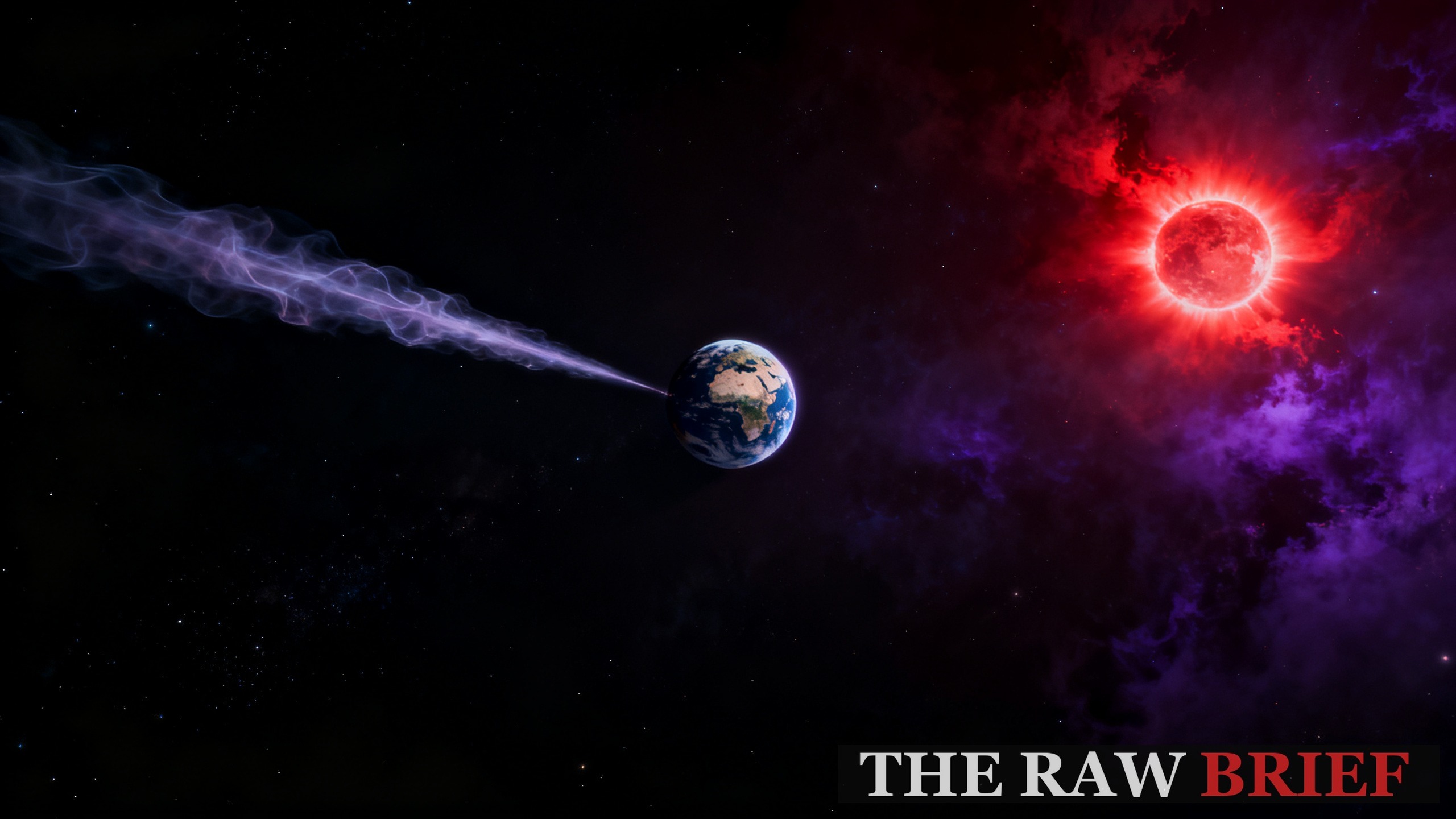
Geophysicist Stefan Burns says a rare convergence of solar activity, comet movement, planetary geometry, severe weather, fireballs and earthquakes is creating one of the most active space-weather periods he has observed.
Burns said the Sun produced two major X-class flares from the region around sunspot group 4419, with additional activity visible near sunspot groups 4420 and 4423. NOAA’s Space Weather Prediction Center reported an X2.5 flare on April 24 from near the northwest solar limb, appearing to originate just northwest of Active Region 4419.
According to Burns, the flares launched large coronal mass ejections into space in the direction of Comet C/2025 R3 (PANSTARRS), which reached perihelion on April 19 and moved toward its closest approach to Earth around April 26. Burns said the comet’s position between the Sun and Earth made the timing especially significant.
“This is the sort of space weather that I’ve been forecasting now for probably about six to eight weeks as a result of this flyby of this comet,” Burns said.
He said the comet’s plasma tail appeared to stretch across a vast distance in satellite imagery and could pass near Earth around April 25 or 26. Burns said he did not expect the tail itself to produce a major geomagnetic storm, but argued it added another unusual factor to an already active solar environment.
NOAA’s space-weather model showed possible impacts around April 26, with Burns saying the agency forecast G1 to G2 geomagnetic storm levels. Burns said he believed the incoming solar wind could be stronger than NOAA’s initial model suggested and speculated that G3 storm conditions were possible.
Burns also linked the timing of the solar activity to a recent outbreak of severe tornadoes in Oklahoma. He pointed to the destructive tornado near Enid, where early images showed homes swept from their foundations, and said the damage suggested the storm could fall in the EF4 to EF5 range. The tornado has since been reported as an EF4, with winds estimated around 170 to 175 mph.
Burns argued that coronal hole high-speed stream impacts have a documented statistical connection to tornado outbreaks in mid-latitude regions, especially during the spring transition period in the Northern Hemisphere.
“We know via the research that there is a very strong statistical correlation between coronal hole high-speed stream impacts and tornado outbreaks,” Burns said.
He said those high-speed streams can affect Earth’s magnetosphere and atmosphere, producing atmospheric gravity waves that may propagate downward into the troposphere. Burns said this can increase vorticity in the days following a high-speed stream impact, creating conditions that may contribute to tornado outbreaks.
“The statistical correlations on this are rock solid,” Burns said.
Burns also pointed to a planetary alignment involving Earth, Venus, Uranus, Sedna and the Pleiades. He described the geometry as highly unusual because Sedna has an approximately 11,400-year orbit around the Sun and is currently moving toward its perihelion, which he placed around 2076 at roughly 76 astronomical units from the Sun.
“This is a once every 11,400-year alignment,” Burns said.
He said Uranus is moving back into a close geocentric alignment with Sedna, with the alignment expected to become more exact in June and July. Burns argued that the previous Uranus-Sedna engagement in 2025 coincided with major seismic activity, including a magnitude 8.8 earthquake near Kamchatka, and said he is watching the current alignment for similar signals.
Burns also noted recent earthquake activity in several regions. He cited three magnitude-five-range earthquakes off Kamchatka, a magnitude 5.8 earthquake near Crete, Greece, and continued activity in the Kermadec Trench north of New Zealand. He said the Crete sequence included several aftershocks and could indicate the possibility of a larger earthquake in the coming days.
Japan was another area of concern for Burns. He said the country has seen major recent seismic activity and pointed to what he described as a historical connection between strong solar flares and large earthquakes near Japan. Burns specifically referenced the March 2011 Tohoku earthquake and said he pays close attention when strong X-class flares ionize the daylight side of Earth near Japan.
Europe also saw a significant fireball on April 24, which Burns described as part of a larger surge in fireball reports since March. He said Europe has recorded 10 fireball events since the beginning of March with more than 80 reports submitted to the American Meteor Society for each event.
Burns said the number of reports suggests Earth may be moving through a new debris stream. He warned that larger objects inside such a stream could pose a serious risk if they entered the atmosphere over a populated area.
The World Meteorological Organization has also said the likelihood of El Niño developing around mid-2026 has increased. Burns said some forecasters believe the event could become strong, with some describing it as a possible “super El Niño.” He argued that a strong El Niño would add another major atmospheric influence to an already active year.
Burns described the combined picture as a convergence of solar, planetary, atmospheric and geophysical factors.
“Right now it’s really, really crazy,” Burns said. “Hopefully things cool down, but in general I think this year is going to continue to be very, very active.”
Burns said he is not predicting the end of the world, but believes the current period deserves close attention because multiple signals are appearing at the same time.
“Things are really wild right now,” Burns said. “There’s no guarantees, but I really hope and pray for the best.”