A senior adviser to Iran's Islamic Revolutionary Guard Corps has offered one of Tehran's clearest public descriptions yet of how it believes it can survive — and potentially outlast — the United States in a prolonged war.
In a rare interview with PBS NewsHour from Tehran, Brig. Gen. Mohammad Reza Naqdi, supreme adviser to the IRGC commander in chief, argued that time is increasingly working in Iran's favor. Rather than portraying a long conflict as something Tehran must escape, Naqdi described continued warfare as an opportunity to gain combat experience, impose attrition on the United States and learn weaknesses in an American military Iran once regarded as more formidable.
The IRGC rarely gives interviews to Western news organizations. The United States has designated the organization as a Foreign Terrorist Organization since 2019, making Naqdi's decision to sit across from PBS special correspondent Reza Sayah particularly unusual.
Naqdi said Iran wanted its message heard directly in Western countries and accused Western media of preventing Iranian voices from reaching foreign audiences. But what followed was more consequential than another complaint about media coverage.
He laid out what sounded increasingly like a doctrine for a long war.
Naqdi claimed Iran had already defeated what he described as Washington's two principal objectives: overthrowing Iran's leadership and breaking the country apart. He portrayed subsequent U.S. policy as confused, pointing to changing American objectives involving Kharg Island, the Strait of Hormuz and military deployments throughout the region.
Those are Iran's claims, not an independent assessment of the battlefield. But Naqdi's explanation of what Tehran believes it is gaining from the war was unusually direct.
"The longer this war lasts, the more experience we gain," he said.
Naqdi said Iran had never previously fought the United States directly on the scale it has during the past five months and argued that the conflict has given Iranian forces a real-world education in American capabilities, tactics and limitations. He went further, saying Iran had discovered that the U.S. military was "weaker than what we perceived."
That assessment is obviously coming from a senior Iranian military figure in the middle of a war and carries an unavoidable information-war component. The strategic point underneath it, however, is harder to dismiss: every additional month of direct conflict gives both sides combat data they did not possess before the war began.
Iran is learning how U.S. forces detect, intercept and respond to Iranian missiles and drones. It is learning what gets through, what gets destroyed, which tactics fail and how American forces respond to saturation attacks and changing launch patterns. The United States is simultaneously learning about Iranian dispersion, targeting, missile production and command structures.
Naqdi's argument is that Iran benefits enough from that process to make prolonging the war part of its strategy.
Asked directly whether Tehran intended to drag the conflict out until President Donald Trump was no longer in office, Naqdi did not reject the premise. Instead, he said one way Iran could establish deterrence was to prolong the war "until we get to the next term of the presidency" while inflicting attrition sufficient to convince future adversaries that attacking Iran carries unacceptable costs.
That is a striking admission.
Iran is not describing victory solely in terms of destroying American forces or forcing Washington to surrender. Its definition of success appears broader: remain standing, continue fighting, make the cost of war politically and economically difficult to sustain and emerge from the conflict sufficiently dangerous that another government thinks twice before repeating it.
Naqdi's most provocative warning came when Sayah pressed him about Iran's missile inventory.
Before the war, outside estimates frequently placed Iran's ballistic missile stockpile in the thousands. After months of launches and repeated American and Israeli strikes against military infrastructure, the size of Iran's remaining arsenal has become one of the most important unanswered questions of the conflict.
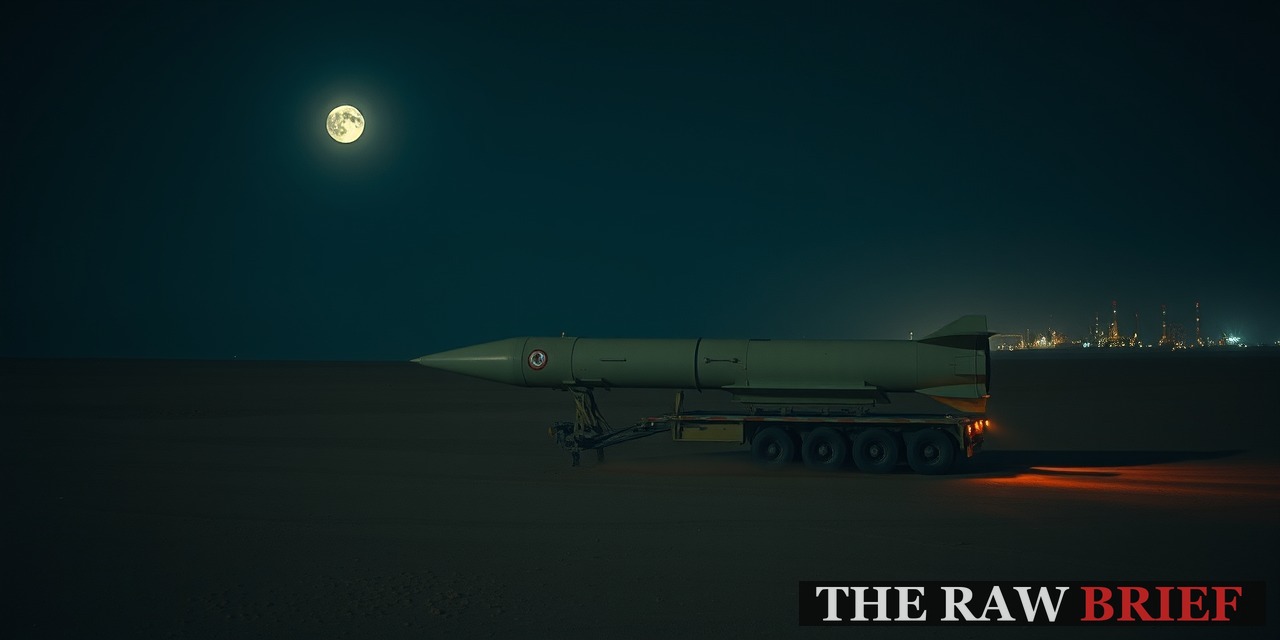
Naqdi refused to provide a number. Instead, he claimed Iran is manufacturing missiles faster than it is firing them and said production can be dispersed across the country's vast territory.
"Even if this war lasts for years," Naqdi said, Iranian rockets would continue launching until the final day.
That claim cannot be independently verified from the interview, and Tehran has strong incentives to exaggerate its ability to replenish an arsenal being targeted by the United States and Israel.
What Naqdi said next was considerably darker.
"If there comes a day when Iran has no more missiles left, that's when we will be even more dangerous for America," he said.
Asked how Iran could become more dangerous after exhausting one of its most important weapons, Naqdi widened the battlefield dramatically.
America, he said, has thousands of economic interests spread around the world that could be destroyed.
The importance of the remark is not that Naqdi identified a specific target; he did not. It is that a senior IRGC adviser appeared to suggest Iran does not view its options as ending with ballistic missiles, drones or attacks confined to the immediate battlefield.
If Iran's conventional military arsenal were badly depleted, his answer implied that Tehran could instead seek asymmetric ways to impose costs against American interests beyond Iran itself.
That philosophy has long been central to Iranian strategy. Tehran cannot match the United States aircraft carrier for aircraft carrier or bomber for bomber, so it has historically relied on geography, missiles, drones, regional armed groups and asymmetric pressure to make conventional American superiority more expensive to use.
The Strait of Hormuz featured prominently in the interview.
Sayah challenged Naqdi over recent Iranian attacks on nonmilitary vessels attempting to pass through the waterway and asked directly why civilian shipping was being targeted.
Naqdi defended Iran's actions by arguing that wartime vessels passing through areas Tehran controls could potentially carry supplies for its enemies. He asserted that Iran had the right during war to control thoroughfares it considers a threat.
His response showed little indication that Tehran intends to separate Hormuz from its broader military strategy. To Iran, the strait is not merely an international shipping route; it is leverage created by geography, and Tehran appears determined to use it as long as the war continues.
Naqdi was equally confrontational when asked about the possibility of the United States using nuclear weapons.
He warned that such a decision would backfire catastrophically, claiming American military bases around the world would be "occupied" the following morning because global public opinion would turn against Washington. He argued that the international environment bears little resemblance to 1945 and that other countries would fear they could eventually become nuclear targets themselves.
There is no obvious mechanism by which all U.S. bases around the world would suddenly be occupied, and Naqdi's prediction should be understood as political rhetoric rather than a literal military forecast.
His answer nonetheless revealed how Iran wants to frame the nuclear question.
Rather than responding to American nuclear superiority by openly endorsing an Iranian bomb, Naqdi insisted Iran does not need one. When Sayah raised the argument that possession of a nuclear weapon might have prevented the United States from attacking Iran in the first place, Naqdi replied that Iran's real "nuclear bomb" was the support it claims to have won among people around the world by opposing U.S. power.
"There is no need for nuclear bombs," he said.
Naqdi adopted similarly ideological language when discussing Israel. He said Iran would prefer that what he repeatedly called the "Zionist regime" cease to exist, but argued that the outcome should come through a political process involving people connected to the land rather than through nuclear destruction.
Sayah also confronted Naqdi over another phrase deeply associated with the Islamic Republic: "Death to America."
Naqdi insisted the slogan was directed at American leadership rather than American citizens, saying Iran had "no enmity with the people of America." He characterized it as condemnation of U.S. governments and their history of military intervention rather than a call for the destruction of the American population.
Some of the interview's most explosive allegations came when Naqdi was asked to put himself in the position of U.S. Defense Secretary Pete Hegseth and predict Washington's next move.
Naqdi refused.
He instead accused Hegseth and other U.S. leaders of being criminals and alleged that American officials manipulate war rhetoric around stock-market trading, becoming more aggressive when markets are closed and sending positive signals when trading resumes.
Naqdi then called for Congress to investigate the assets of Trump, members of his family and his inner circle before and after the war.
He offered no evidence in the interview to substantiate those allegations. They remain accusations by a senior official of a government currently at war with the United States, not established findings.
The exchange nevertheless illustrated how Tehran is increasingly trying to fight the conflict on a second battlefield: American domestic politics.
Iranian officials have repeatedly emphasized the cost of the war, U.S. weapons consumption, energy prices and political divisions inside the United States. Naqdi's suggestion that Iran could pursue attrition until another presidential term fits that strategy almost perfectly.
His message is that Tehran does not necessarily have to defeat the United States militarily in the conventional sense if it can make Americans decide that continuing the war is no longer worth the cost.
Near the end of the interview, Sayah asked about another mystery surrounding Iran's wartime leadership: the absence from public view of Supreme Leader Ayatollah Mojtaba Khamenei, who succeeded his father after Ali Khamenei was killed during the opening phase of the war. Mojtaba Khamenei has remained largely out of public view since taking power.
Naqdi said the reason was security.
He also made clear that the absence should not be interpreted as a lack of control, saying Iran's wartime strategy belongs to the supreme leader. When pressed on whether he had personally seen Khamenei, Naqdi abruptly ended that line of questioning.
The White House responded to Naqdi's interview with a short warning. PBS reported that the administration said Iran would be wise to agree to a deal, adding that otherwise Tehran "knows what will happen."
But perhaps the most important message in the interview was that Iran no longer appears to view a quick deal as the only acceptable outcome.
Naqdi described a country that believes it is becoming more experienced every month the war continues. He said Iran can replenish the missiles it is firing, claimed American military power has proven less intimidating than Tehran expected and openly described attrition extending into another U.S. presidential term as one path toward deterrence.
Most strikingly, he suggested that even destroying Iran's conventional missile arsenal would not necessarily end the threat.
In Naqdi's telling, empty missile racks would simply force Iran to change the way it fights.
That is the warning Washington should take seriously, regardless of how much of the rest of his interview was propaganda: Tehran is presenting this war not as a finite exchange of missiles, but as a contest over which side can adapt, endure and continue imposing costs longer.
Five months into the conflict, Iran is saying openly that it believes time is becoming a weapon.
And it intends to use it.