Something important happened in Mecca on Friday, and it says more about the Iran war than another night of missile launches.
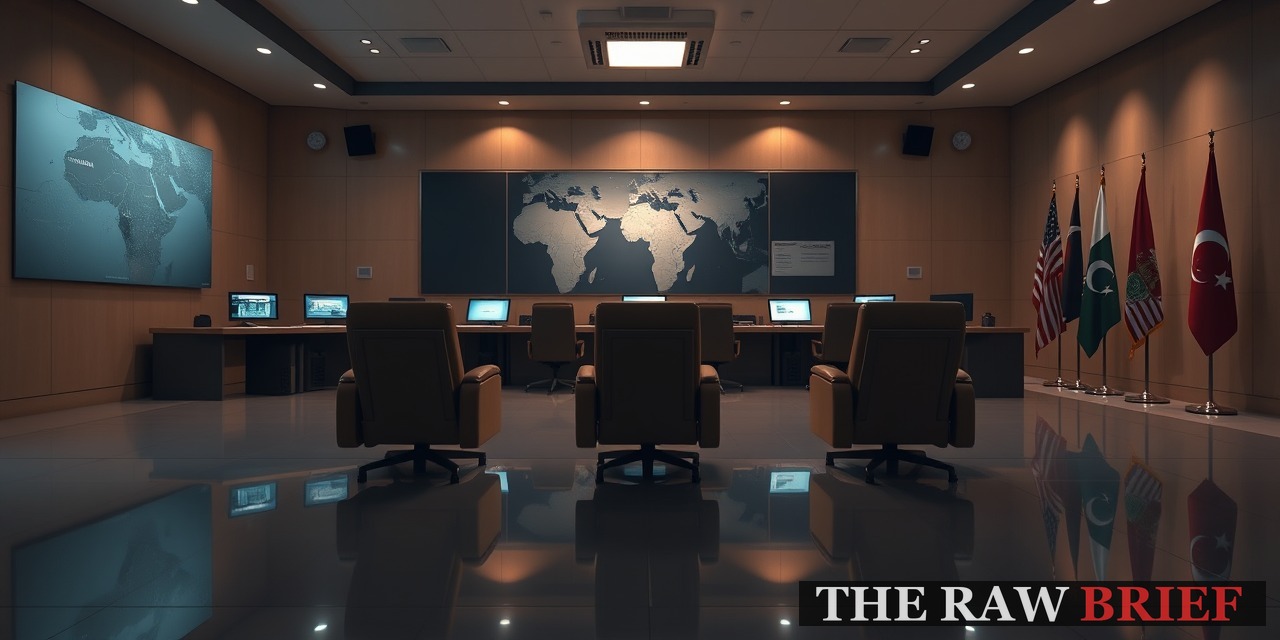
Saudi Arabia, Turkey and Pakistan signed a joint defense agreement declaring that an armed attack against one of the three countries will be treated as an attack against all. The agreement brings together Saudi money and strategic geography, Turkey’s large military and growing defense industry, and Pakistan, the Muslim world’s only nuclear-armed state.
Saudi officials insist this is not an “Islamic NATO,” a nuclear alliance or a bloc directed against Iran. The agreement also leaves important questions unanswered about exactly what each country would be required to do if another were attacked.
But the timing is impossible to ignore.
Saudi Arabia has spent decades relying heavily on the United States as the ultimate guarantor of Gulf security. Five months into the Iran war, Riyadh is now building another layer of protection around itself with two major regional military powers.
That does not mean Saudi Arabia is abandoning Washington. It means Saudi Arabia is hedging.
There is a reason for that.
Reuters reported this week that the United States has used virtually all of its available Army Tactical Missile Systems and Precision Strike Missiles during the war with Iran. The U.S. has also burned through slightly less than half of its worldwide Tomahawk inventory, according to one source familiar with the numbers.
Trump disputes the suggestion that America is running dangerously low. He says the United States still has more munitions than it needs and points to rapidly expanding defense production.
Both things can be true.
The United States remains the most powerful conventional military force in the world, but some of the weapons that made American power relatively safe to project from long distances have been consumed at an extraordinary rate. Replacing sophisticated missiles is not the same as replacing rifle ammunition. Production lines, specialized components and industrial capacity matter, particularly when the same weapons are expected to deter Iran, support Ukraine and remain available for a possible conflict in Asia.
That is where the Iran war begins to look bigger than Iran.
Saudi Arabia is simultaneously warning that intelligence indicates Iran-aligned Iraqi militias could attack from the north while the Houthis attack from Yemen in the south. A senior Saudi official told Reuters that drones and missiles had been observed moving and that potential targets included ports, airports and energy infrastructure.
An attack in southern Saudi Arabia wounded 11 civilians Thursday, while the Houthis and Iran-aligned Iraqi militias have already demonstrated that the kingdom can be pressured from multiple directions.
Riyadh therefore has to ask a question that American allies rarely had to ask so openly during the post-Cold War era: What happens if Washington cannot protect everything at once?
Turkey and Pakistan are part of the answer.
The agreement does not replace the United States, but it reduces the danger of having only one security guarantor. For Saudi Arabia, that is rational insurance after months of watching missiles and drones penetrate a region covered by some of the most sophisticated American air-defense systems ever built.
Europe has been making its own calculations.
When Trump pressured allies earlier this year to help secure the Strait of Hormuz, European governments resisted expanding their naval mission into the waterway. EU foreign policy chief Kaja Kallas said there was “no appetite” for changing the mandate, even though Europe had enormous economic interests in restoring normal energy flows.
Europe was willing to protect shipping and pursue diplomacy. It was far less willing to become another combat arm of Washington’s Iran strategy.
That distinction matters because American power has never rested on missiles alone. It rested on an alliance system in which Washington could usually assume that its partners would eventually move in the same direction.
That assumption is becoming less reliable.
Former national security adviser H.R. McMaster spent years warning against what he called the “vampire fallacy,” the recurring belief that superior technology could fundamentally change the nature of war. Precision weapons, surveillance systems and information dominance could make conflict appear cleaner, faster and more predictable than history suggested.
Iran has provided a brutal demonstration of the problem.
The United States can destroy Iranian targets with extraordinary precision, but destroying targets is not the same as achieving a political outcome. Iran survived the initial assault, kept fighting, disrupted Hormuz and forced Washington into a prolonged contest that consumes expensive weapons much faster than planners expected.
American technology remained superior.
The war remained a war.
That distinction is now showing up in places far beyond the battlefield.
Russia has benefited from higher global energy prices created by Middle East disruption. Reuters calculated that Russian state oil and gas revenues were on course to rise about 60% year over year in July, helping Moscow finance a war in Ukraine that Washington has spent years trying to contain.
The irony is difficult to miss. A war intended to weaken Iran helped lift energy prices that strengthened Russia, while the weapons consumed in the Middle East became weapons unavailable for other contingencies.
This does not mean Pax Americana has suddenly collapsed. The United States still has military bases across the Gulf, enormous economic influence, NATO, the world’s dominant reserve currency and a defense budget no regional rival can match.
But raw strength and usable strength are not identical.
A Tomahawk sitting in inventory can deter several adversaries at once. Once it is fired at Iran, it cannot also be available for Europe or the Pacific.
An American security guarantee can reassure several allies at once. Once those allies begin wondering whether Washington has enough weapons, political attention and willingness to defend all of them simultaneously, they begin purchasing insurance elsewhere.
That is what makes the Mecca agreement significant.
Saudi Arabia is not turning against America. Turkey remains a NATO member. Pakistan still has deep military ties with Washington. None of them appears interested in replacing the United States with Iran, China or Russia.
They are doing something more subtle.
They are preparing for a world in which America might not always be enough.
For three decades after the Cold War, Washington rarely had to confront that problem. American military power was so dominant that allies could outsource much of their security while adversaries generally avoided testing the system directly.
Iran has not defeated that system.
It has exposed its limits.
The United States can still hit almost anywhere. What it cannot do cheaply is fight prolonged wars across several theaters, defend every ally, protect every shipping lane, replenish every interceptor and simultaneously preserve enough high-end weapons for Russia and China.
America still has enormous power.
Its allies are simply no longer betting everything on it.