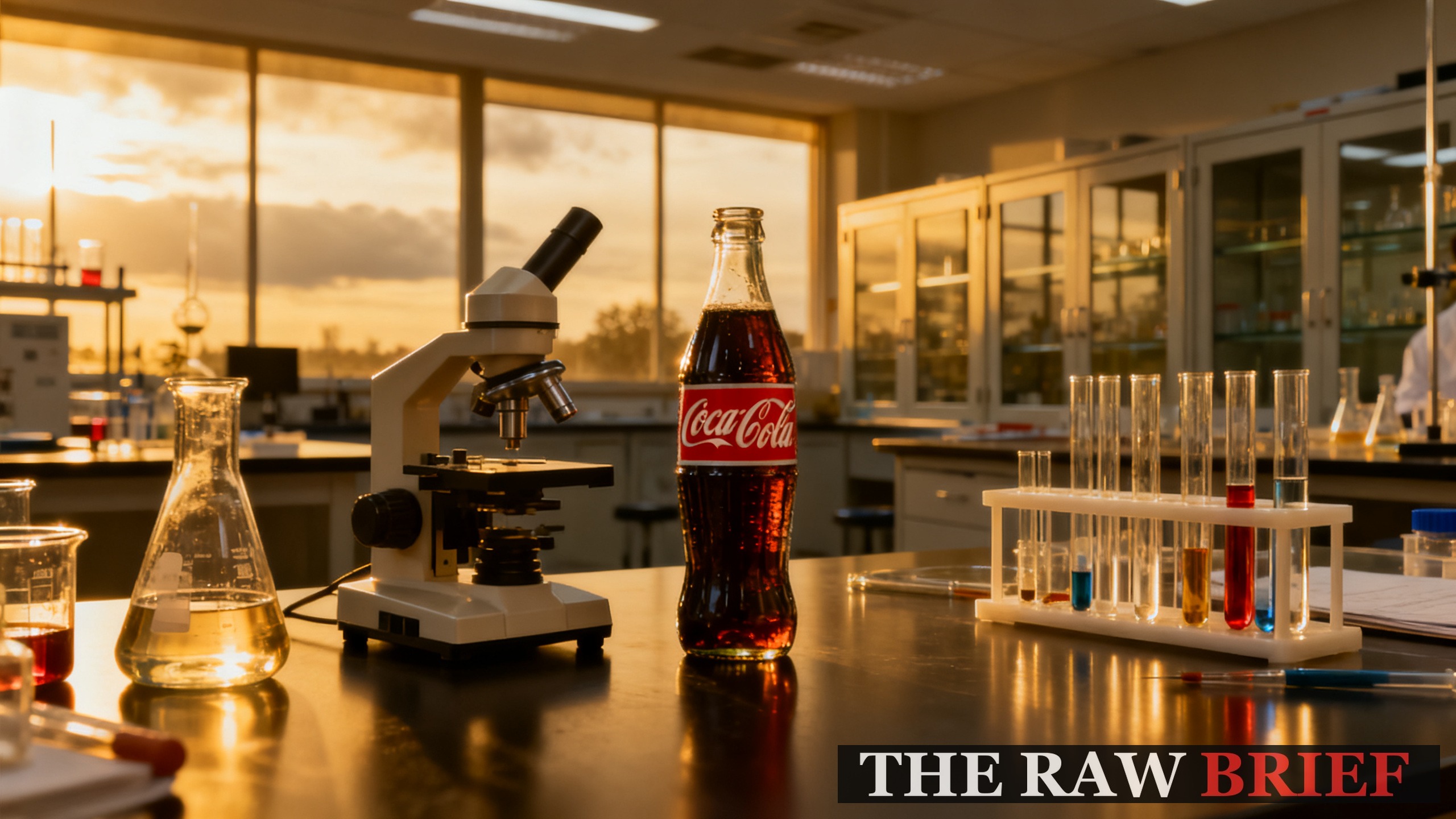
YouTuber Zach Armstrong of the LabCoatz channel says he has recreated a Coca-Cola-style soda after spending nearly a year analyzing the drink’s flavor chemistry, testing essential oils, and comparing his results against the original beverage.
Armstrong said Coca-Cola’s formula remains one of the most famous trade secrets in the world because the company never patented the recipe. A patent would require public disclosure, he said, while keeping the formula as a trade secret allows Coca-Cola to protect it without revealing the details.
“Coca-Cola hasn’t actually patented their recipe,” Armstrong said. “Doing so would require them to expose what they’re patenting, and that’s obviously not something they want to do.”
The project began with a simple question: could modern chemical analysis reveal enough of Coca-Cola’s flavor profile to make a convincing replica? Armstrong pointed to a 2016 article that suggested mass spectrometry could theoretically be used to decode the recipe, though the author believed the work would require the resources of a major organization.
Armstrong said he was able to attempt the project with help from two other science creators, Vince from Neptunium and Ben from Mass Spec Everything, who analyzed Coca-Cola, Pepsi, and Armstrong’s test ingredients using mass spectrometry.
The analysis identified several major compounds in Coca-Cola, including alpha-terpineol, limonene, 4-terpineol, fenchol, cinnamaldehyde, sabinene, carene, eucalyptol, borneol, furfural, and ethyl levulinate. Armstrong said those compounds pointed toward a flavor base built around citrus oils, cinnamon, nutmeg, caramel color, and other trace ingredients.
He said one of the largest flavor peaks was alpha-terpineol, a compound that can arise from the acid-driven breakdown of citrus components such as limonene and pinene. Limonene itself was also detected, reinforcing the importance of lemon and lime oils in the drink’s flavor.
Cinnamaldehyde pointed toward cinnamon, while sabinene and carene helped support the presence of nutmeg-like flavors. Furfural was linked to caramel color, and ethyl levulinate suggested that sugar compounds may be heated under acidic conditions during production.
Armstrong said the mass spectrometry data helped reveal what was present, but not the exact concentrations. To refine the formula, he also relied on published food chemistry research that listed measured concentrations of many Coca-Cola flavor compounds.
One surprising discovery, he said, was acetic acid. Armstrong said acetic acid, the main acid in vinegar, appeared as one of the most prominent flavor compounds by mass. At first, he thought it might have formed from the breakdown of other ingredients, but after comparing notes with Darcy from the Art of Drink channel and reviewing an older cola recipe, he concluded it was likely added deliberately in tiny quantities.
“To be clear, the amounts being used are in the parts per million range,” Armstrong said. “But I still find it funny that vinegar is probably one of the secret ingredients.”
Armstrong said his early trials relied on common cola-recipe ingredients such as orange, lemon, lime, coriander, nutmeg, cinnamon, vanilla, and neroli. He eventually found that lemon, lime, nutmeg, cinnamon, and coriander were more important to the modern Coca-Cola profile, while neroli, lavender, clove, and large amounts of orange pushed the flavor away from real Coke.
He said the drink also needed a “green” freshness that many cola replicas miss. Since Coca-Cola is known to use decocainized coca leaf extract, Armstrong searched for a way to mimic part of that profile without using coca leaves. He eventually turned to tea tree oil as a source of 4-terpineol, a compound detected in Coca-Cola and present in high amounts in tea tree oil.
Armstrong said tea tree oil improved the replica immediately, but something was still missing. The drink tasted closer to Diet Coke than regular Coca-Cola, he said, and months of adjusting essential oils did not fully solve the problem.
The breakthrough came when he considered that coca leaf extract functions somewhat like a tea extract. Tea-like extracts contain tannins, which produce a dry, astringent taste. Armstrong said those tannins help mask sweetness and add a missing texture to the flavor.
Because tannins are non-volatile, he said, they would not usually appear in gas-based mass spectrometry. That helped explain why the flavor was missing from earlier attempts. Armstrong eventually used purified wine tannins, which he said made the replica come together.
“This is the mass spectrum of Coca-Cola,” Armstrong said. “And this is the mass spectrum of one of my replicas. They’re nearly identical.”
Armstrong emphasized that his version is not Coca-Cola’s actual secret formula. He said he did not use decocainized coca leaf extract, which remains one of the confirmed natural flavor components associated with Coca-Cola. Instead, he said his goal was to reproduce the major flavor chemistry closely enough to create a drink that tastes like the real thing.
The final version uses a combination of lemon oil, lime oil, a small amount of orange oil, tea tree oil, cassia cinnamon, nutmeg, coriander, fenchol, caramel color, caffeine, phosphoric acid, vinegar, glycerin, vanilla, wine tannins, sugar, and carbonated water.
Armstrong said the startup cost is high because the recipe requires essential oils, accurate measuring tools, and food-safe ingredients such as phosphoric acid and caffeine. But once the concentrated flavor solutions are prepared, he said, the cost per serving becomes extremely low.
“Once you have everything, you can easily produce a bulk flavor solution that will last for years and allow you to create a serving of Coke for mere pennies,” he said.
The finished drink was tested against real Coca-Cola in several blind and non-blind taste tests. Armstrong said regular Coke drinkers were better at spotting the difference, but many testers still described the replica as convincingly close.
One tester rated it 9.5 out of 10. Another said it tasted close enough that they might not be able to tell the difference side by side. A third said, “That’s a Coke product. I wasn’t expecting it to taste so much like Coke.”
Armstrong said his version was much closer to Coca-Cola than other recipes he tested, including older Pemberton-style formulas and open-source cola clones. He said those older recipes often tasted too floral, too cinnamon-heavy, or more like generic cola than modern Coke.
For Armstrong, the project showed that Coca-Cola’s flavor can be approached through chemistry rather than folklore. The company’s exact formula may still be locked away, but he said the major flavor profile can be reconstructed with enough analysis, testing, and patience.
“It definitely checks out as Coca-Cola, at least to me,” Armstrong said. .